


Health x Wellness
Molecular “Reset”: Duke-NUS Scientists Discover How Exercise Repairs Ageing Muscles
Scientists at Duke-NUS Medical School have identified a specific gene, DEAF1, as a primary driver of muscle decline in ageing.
Their research reveals that physical activity serves as a biological “reset,” activating proteins that suppress this gene to restore the natural balance of muscle growth and repair.
The study, published in the Proceedings of the National Academy of Sciences (PNAS), explains the molecular mechanism behind why exercise remains the most effective intervention for preserving strength and mobility in later life.
The Discovery of the DEAF1 Imbalance
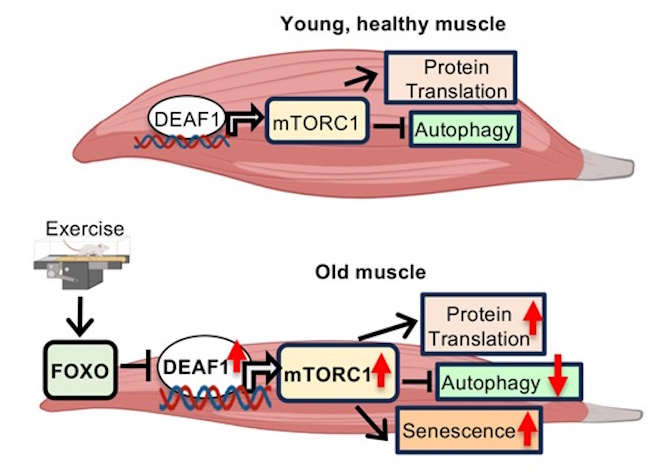
In healthy muscle, a growth pathway called mTORC1 regulates protein production and tissue maintenance. However, as muscles age, this pathway can become overactive, prioritising the building of new proteins while failing to clear out damaged ones.
The Duke-NUS team discovered that this imbalance is driven by the DEAF1 gene:
- Loss of Control: In younger muscles, a group of proteins called FOXOs keeps DEAF1 levels in check.
- The Ageing Trigger: As FOXO activity naturally declines with age, DEAF1 levels rise unchecked, pushing the mTORC1 pathway into overdrive.
- Muscle Weakening: This disruption prevents muscle cells from “cleaning up,” leading to an accumulation of damaged proteins that stresses and weakens the tissue.
To validate these findings, researchers conducted experiments on fruit flies and older mice; in both models, increasing DEAF1 led to rapid muscle weakness, while lowering it restored muscle strength.
How Exercise Acts as a “Rewind Button”
Physical activity addresses this cellular stress by re-activating the regulatory system. Assistant Professor Tang Hong-Wen, the study’s lead author, explained that exercise triggers proteins that lower DEAF1 levels.
“Exercise tells muscles to ‘clean up and reset,’” added Priscillia Choy Sze Mun, the study’s first author. “Lowering DEAF1 helps older muscles regain strength and balance, almost like hitting the rewind button”.
However, the researchers noted a critical caveat: if DEAF1 levels are too high or FOXO activity is severely reduced—as often seen in very old muscles—exercise alone may not be enough to fully restore the repair process. This finding underscores why some individuals may see fewer benefits from physical activity than others.

Implications for Future Therapies
Beyond general ageing, the discovery of DEAF1’s role has significant implications for broader medical recovery:
- Surgical and Illness Recovery: Adjusting DEAF1 levels could help patients recovering from surgery, cancer, or chronic conditions maintain muscle mass.
- Limited Mobility Support: Researchers hope to eventually mimic the molecular effects of exercise, helping those with limited physical activity stay strong.
- Muscle Stem Cells: Because DEAF1 influences the stem cells responsible for tissue regeneration, targeting this pathway could specifically improve recovery speed after injury.
“By identifying DEAF1 as a key regulator, these findings may lead to new ways in which the benefits of exercise can be brought to societies with rapidly ageing populations,” said Professor Patrick Tan, Senior Vice-Dean for Research at Duke-NUS.
Graphic courtesy of Duke-NUS Medical School. Picture credit to Freepik.